
Support Systems in Grief
I was describing my grief over my deceased son to a friend. When I finished, the friend said that they had been dealing with grief and loss, too—their friend had just moved to a different state.
It’s okay to laugh. I didn’t for a few years, but I do now. (And by the way, I’ve said dumb stuff since my son’s death…when you think I’d “know better.”)
I think it’s fair to say we struggle with how to talk about death and how to support those who are grieving.
Enter Ring Theory!
Support in. Dump out.
A series of concentric circles, the griever is the innermost circle. Next might be a partner, close family member, or friend. Stepping out further would be other friends. After that, colleagues and acquaintances. Then, society at large. Or, some variation of this, you get the idea.
The rule of thumb is that circles further out should be providing support to circles closer in. If the outer circles want to vent or need support, they should be looking toward a circle that is further out from them. Especially when the innermost circle is in acute grief.
Support in. Dump out.
The idea is for a support network to be truly supportive—grief comparisons are not helpful to a person in acute pain. Venting is not beneficial to a person already struggling. But listening, compassion, and specific helpful actions can often be supportive for those grieving.
While there are critiques of this theory (i.e. censorship, personality variations, multiple grievers in the same circle), I find it a helpful framework to explore with grievers. I even use blank concentric circles to get the conversation going.
Who would be in your rings? Which way is the support going?
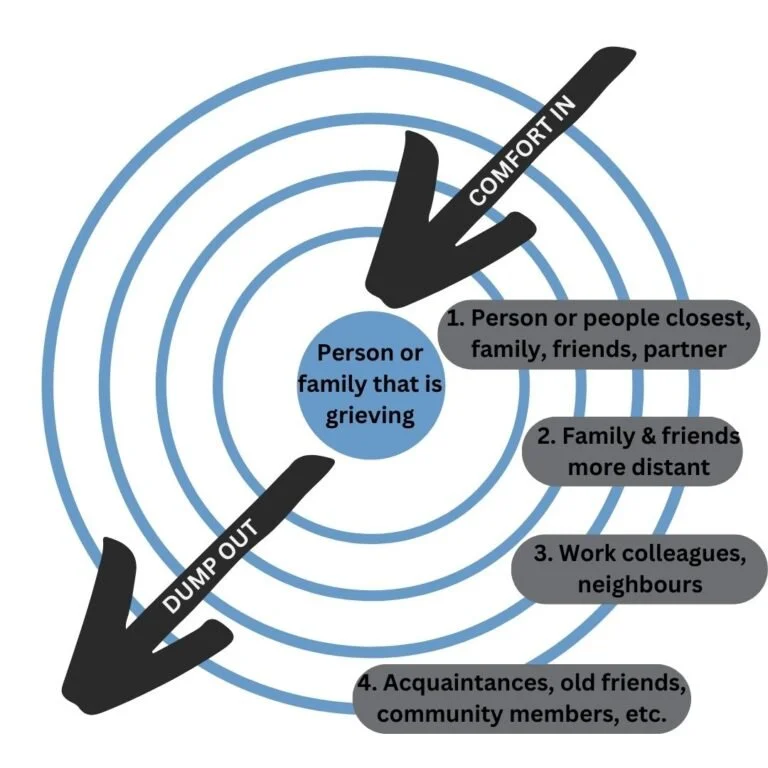
Image: Grief Stories
Silk, S., & Goldman, B. (2013). “How Not to Say the Wrong Thing.” Los Angeles Times. 7 April.
