The Dual Process Model
There’s so much frustration, confusion, self-doubt, guilt—you name it!—in grief.
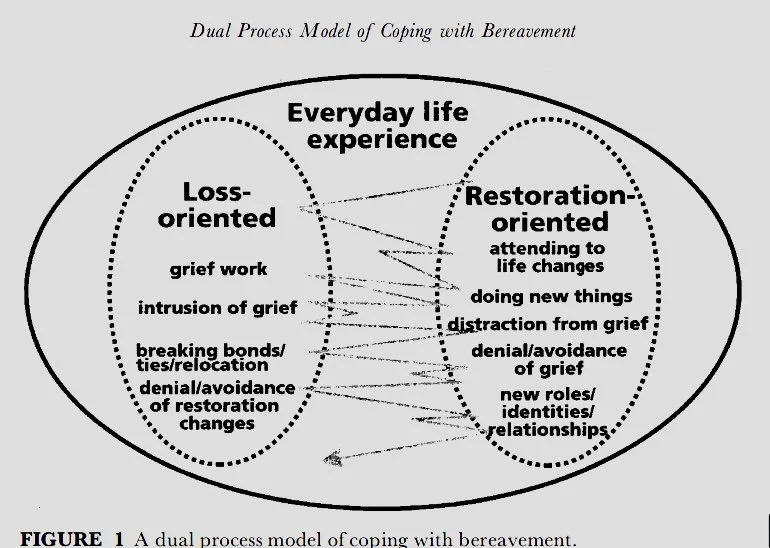
One of my favorite things to talk about with both youth and adult grievers is the Dual Process Model. I find that when we discuss the concept of “oscillation” (all those lines in the middle) between “loss-oriented coping” and “restoration-oriented coping,” most grievers have sort of a “huh” moment.
Hearing that “dosing” grief is a natural, regulatory process typically lessens the concerns surrounding guilt or feelings of “going crazy.” Hearing that grief often looks “messy” can be validating. Hearing that it’s actually healthy to go back and forth between grieving and living as you assimilate a loss can be affirming.
For example, a mother may cry over her deceased son’s shoes still sitting in his cubby (loss-oriented coping), then attend a mother’s day celebration at her living son’s preschool (restoration-oriented coping). That’s enough to make your head spin. But, the DPM gives us a framework to understand this “dosing” of grief—it normalizes both the grieving part and the living part.
I love to see how grievers draw their own lines between examples of loss and restoration. Sometimes they’re spiky and pinging back and forth. Sometimes they hover more to one side.
How would you draw your experience of grief? In those early, raw days? In those later months, years? On milestones, anniversaries? On a random weekday?